


If you're a Ford owner who can't get enough, or who just wants something to read on a Sunday afternoon, Ford now has an e-magazine to keep you up-to-date. In their current edition, they cover the life of one of their original racing gurus, Carroll Shelby. If you know anything about Ford and racing, you've heard the name Shelby. Click here to read more about this racing legend.
source: www.myfordmag.com
Monday, October 22, 2012
Ford's E-magazine Covers the Life of Carroll Shelby
Posted by Laurel Auto Group on 8:17 AM
What To Do When You Take The Car In
Posted by Laurel Auto Group on 7:42 AM
Taking the car in for repairs can lead to a discussion with a mechanic who knows each part of every last car, but how do you know that the suggestions you get are worth your dollar? Car and Driver reports on which extras to choose when you go in for a check-up: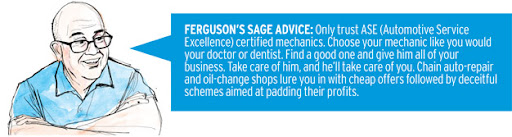
Any time we take a car into the shop and someone starts a sentence with “You know, while we’ve got it in here . . .” our BS meter goes off. Is he looking to help us out or just to make a quick buck? We asked longtime C/Dfriend, master mechanic, and auto-service instructor Russ Ferguson his thoughts on several common upsells. Their utility is rated on the Ferguson scale, which is to say out of five stars.
Read the full story here.
Source: blog.caranddriver.com
Businesses get Creative with Support for United Way
Posted by Laurel Auto Group on 7:34 AM
The local Tribune-Democrat reports on how businesses are getting creative in their support for the United Way.
Dave Sutor
— Businesses across Cambria and Somerset counties find simple, creative and fun ways to raise funds for the United Way of the Laurel Highlands every year.
There are car washes, Wii competitions, dart tournaments, gift-card giveaways, paid days off, limo lunches, turkey trots and more. Some companies offer easy payroll deductions.
Wednesday, October 17, 2012
How to Share the Road with Truckers
Posted by Laurel Auto Group on 5:27 AM

Everybody has a horror story to tell about an encounter they've had with an 18-wheeler on the Interstate, and how they were nearly killed by the inattentiveness of the truck driver. News programs like Dateline NBC and 60 Minutes feed this fear with selectively edited stories regarding truck safety. But what nobody seems to consider is that they themselves may have caused the problem because of ignorance about what is involved in driving a truck, or by engaging in righteous driving behavior that did nothing but endanger their own lives and those of the people they care most about.
Personally, we've seen rude truckers hog the road, and we've seen dimwitted drivers set themselves up for what could be a very painful, if not deadly, lesson. Furthermore, not all trucks traveling the nation's highways are properly maintained, due to a lack of finances or pure laziness. But for most truck drivers, who are paid by the mile and are held responsible for damaged goods, their lives and livelihoods depend on driving a well-maintained truck carefully, and getting freight to its destination on time.
Tractor trailer trucks are responsible for carrying nearly 30 percent of all the cargo shipped in the United States. Technology and improved roadways have allowed the use of trucks for shipping to increase steadily since the 1920s, resulting in larger vehicles and heavier loads. Yet, traffic fatalities involving trucks have steadily declined during the past 50 years, except for a small spike upward in the early 1980s right after the trucking industry was deregulated. Fatalities due to accidents involving semi trucks total 5,000 annually on average, with the vast majority of those fatalities suffered by occupants of passenger vehicles that collided with a truck. As motorists who must share the road with semi trucks, we can do our part to help reduce this number even further if we simply take the time to follow a few simple driving rules and try to understand how difficult it is to maneuver a tractor-trailer in traffic.
We asked Michael Taylor, transportation special programs developer for the Tractor Trailer Training Program at Triton College in River Grove, Ill., what the top five pet peeves truckers had with fellow motorists were. Here is his list:
1) Riding in a trucker's blind spots. Trucks have large blind spots to the right and rear of the vehicle. Smaller blind spots exist on the right front corner and mid-left side of the truck. The worst thing a driver can do is chug along in the trucker's blind spot, where he cannot be seen. If you're going to pass a truck, do it and get it over with. Don't sit alongside with the cruise control set 1 mph faster than the truck is traveling.
2) Cut-offs. Don't try to sneak into a small gap in traffic ahead of a truck. Don't get in front of a truck and then brake to make a turn. Trucks take as much as three times the distance to stop as the average passenger car, and you're only risking your own life by cutting a truck off and then slowing down in front of it.
3) Impatience while reversing. Motorists need to understand that it takes time and concentration to back a 48-foot trailer up without hitting anything. Sometimes a truck driver needs to make several attempts to reverse into tight quarters. Keep your cool and let the trucker do her job.
4) Don't play policeman. Don't try to make a truck driver conform to a bureaucrat's idea of what is right and wrong on the highway. As an example, Taylor cited the way truck drivers handle hilly terrain on the highway. A fully loaded truck slows way down going up a hill. On the way down the other side of the hill, a fully loaded truck gathers speed quickly. Truckers like to use that speed to help the truck up the next hill. Do not sit in the passing lane going the speed limit. Let the truck driver pass, and let the Highway Patrol worry about citing the trucker for breaking the law.
5) No assistance in lane changes or merges. It's not easy to get a 22-foot tractor and 48-foot trailer into traffic easily. If a trucker has his turn signal blinking, leave room for the truck to merge or change lanes. Indicate your willingness to allow the truck in by flashing your lights.
According to "Sharing the Road," a booklet distributed by John Deere Transportation Insurance, the three most common types of accidents involving heavy trucks involve the following:
1) Crashes caused by the truck's inability to stop in time.2) Crashes caused by a motorist trying to pass a truck on the right while the truck is making a right-hand turn. Also known as the right turn squeeze.3) Crashes caused by a motorist riding in the trucker's blind spots. Use the following rule of thumb: If you cannot see the truck driver in his mirrors, he probably cannot see you.
By taking simple common-sense steps to protect yourself and your family when driving near large trucks, traffic fatalities will continue to drop. Over the years, the trucking industry has improved the quality of truck drivers by making it more difficult to qualify for and keep a Commercial Driver's License (CDL). Mandatory drug testing has also been instituted. In fact, the National Highway Traffic Safety Administration (NHTSA) published the following data in 2008. The intoxication rate for drivers involved in fatal accidents was:
27% for motorcycle riders 23% for light truck drivers (pickups and SUVs, that is) 23% for passenger car drivers 1% for truck drivers
Still, more work must be done to combat tightly scheduled deliveries, overbearing stacks of paperwork and driver fatigue caused by federal regulations that work against the human body's natural circadian rhythm.
After meeting with truck driving instructors at Triton College, with representatives from the Illinois Transportation Association and learning what it takes to pilot a tractor-trailer by taking the wheel myself, we joined Taylor for a ride in a brand-new empty tanker truck.
We covered suburban roads during a half-hour loop just to the southeastern side of O'Hare airport. During our 30-minute ride, two motorists turned left across traffic directly in front of the truck. One young woman in a Toyota Celica crossed no more than 50 feet in front of us as she zoomed onto a side street. An older couple in a Dodge Grand Caravan turned in front of our International tractor, and incredibly, slowed so they wouldn't scrape the van on a steep driveway apron to a convenience store. A dude in a Camaro RS blasted by on the left, cut in front of the truck and stopped at a red light we were approaching. When the light turned green, he turned right.
These are the kinds of driving habits that we must break for truck-related accident rates to drop even lower. After a day at truck driving school, we left Chicago for Denver in a Subaru Outback. During that evening and the next day traveling I-80 and I-76, we were keenly aware of the needs of the truckers with whom we shared the road. We behaved more courteously toward truck drivers and fellow motorists than usual, and exercised more patience. We doubt very much that by driving more defensively and less aggressively we arrived in Denver any sooner than we would have had we not let that Kenworth into our lane back in Iowa or had we tried to beat that Freightliner to the construction zone near Lincoln, Neb. We do feel, however, that our trip was a safer one, that we had done our part to make highway travel better. Now it's time to do yours.
Source: Edmunds.com
Thursday, October 11, 2012
Win a New F-150 and a Weekend Tour with Toby Keith!
Posted by Laurel Auto Group on 9:57 AM

What do the new 2013 F-150 and superstar Toby Keith have in common? They can both be yours in the Toby Keith Live in Overdrive Sweepstakes. Enter today for a chance to win a new F-150 with EcoBoost and a weekend on tour with Toby Keith. What are you waiting for? http://goo.gl/VNIeF.
Friday, May 11, 2012
How Moms Saved Ford
Posted by Laurel Auto Group on 12:12 PM
As Mother's Day comes once again, we are reminded of the role they've played throughout history and in particular the role they've played in the history of the Ford Motor Company. The Joplin Globe has a great brief piece on this story:
Sunday is Mother’s Day, a time to honor those who raised us. For one auto family, the holiday symbolizes something even more profound: mothers who saved the family business. The company in question? Ford.
Henry Ford established Ford Motor Co. in 1903 at age 40. Five years later, he introduced the Model T, a car that changed America forever.
Ford retained an iron grip on the company despite his advancing years. Always unpredictable, Ford grew more so as he aged. No one knew this better than Henry’s only son, Edsel, who served as Ford Motor Co. president. The elder Ford often undermined his son in an effort to toughen him up.
On May 23, 1943, Edsel, then 49 years old, died of cancer and undulant fever. Incredibly, his father, age 80, appointed himself president of Ford.
The U.S. government became concerned as the company’s condition deteriorated. Ford was one of their largest wartime contractors. Edsel’s wife, Eleanor, and his mother pressured Henry to turn it over Ford Motor Co. to their grandson, Henry II. The old man was reluctant.
Only when young Henry’s mother, Eleanor, threatened to sell her stock did old Henry relent. The government released Henry II from military service and, on September 21, 1945, Eleanor’s son took the helm and soon returned Ford to health.
Two mothers — Henry’s and Edsel’s — had saved Ford Motor Co.
Wednesday, May 9, 2012
Ford Focus EV
Posted by Laurel Auto Group on 11:42 AM

Ford's forthcoming Focus EV is set to have a feature unique amongst EVs—wireless charging! Using a floor-placed disc which will wirelessly transfer power to the vehicle when in position, you won't even have to plug it in. The San Francisco Chronicle has a great article on the upcoming technology:
You’re likely to be hearing a lot about Ford’s 2012 Focus Electric this week. Ford is in town with its new electric car, and will be giving test drives to members of the media, “electric auto enthusiasts, stakeholders and curious members of the public for this event.”
The event is set for 10 a.m. to noon, Thursday, May 10, at Hermann Square Park, 900 Smith Street – directly in front of City Hall.
Ford reports “the all-electric Focus is capable of fully recharging in three to four hours at home using the available wall-mounted 240-volt charge station – charging in half the time of the Nissan Leaf.”
Plugless power is a new concept of hands-free, wireless charging stations. The Plugless Power by Virginia-based Evatran is a disc you park on the floor of your garage. The disc relays the charge wirelessly and automatically via a receiver mounted to the underside of the vehicle that’s been hard-wired to the EV’s existing on-board charger.
The wireless system does not connect with or affect the external “outlet,” so you can still recharge conventionally, with a cord and plug, at any plug-in charging station. Right now, Plugless Power is available for the Chevrolet Volt and Nissan Leaf, but is also being expanded to include other models.We can't wait to see the results when this hits the market!
Meanwhile, Toyota and Mitsubishi are partnering with Massachusetts-based WiTricity on a different system of wireless recharging. Although this system also requires a device embedded in the vehicle to connect with an energy-transmitter in the parking spot, the two systems differ in how the electric charge is transmitted. This one uses magnetic resonance, not inductive power, and it’s several years from real-time testing.


